Embarrassingly Small List of Followers

Monday, October 19, 2015

Creating Art from Spilt Coffee

Countless times, I have come downstairs to make my coffee in the morning and encountered unmistakable signs that my teenage daughter has already been there and left her mark.  Spills and spatters of brown liquid, scattered coffee grounds, abandoned spoons were left to greet me.  I used to feel aggravated, and I would let her know, yelling up the stairs that I did not appreciate the mess.  There would be no response from her and no behavioral transformation as a result of my anger.  These exchanges were typical of our relationship as we tried to navigate the teenage years.

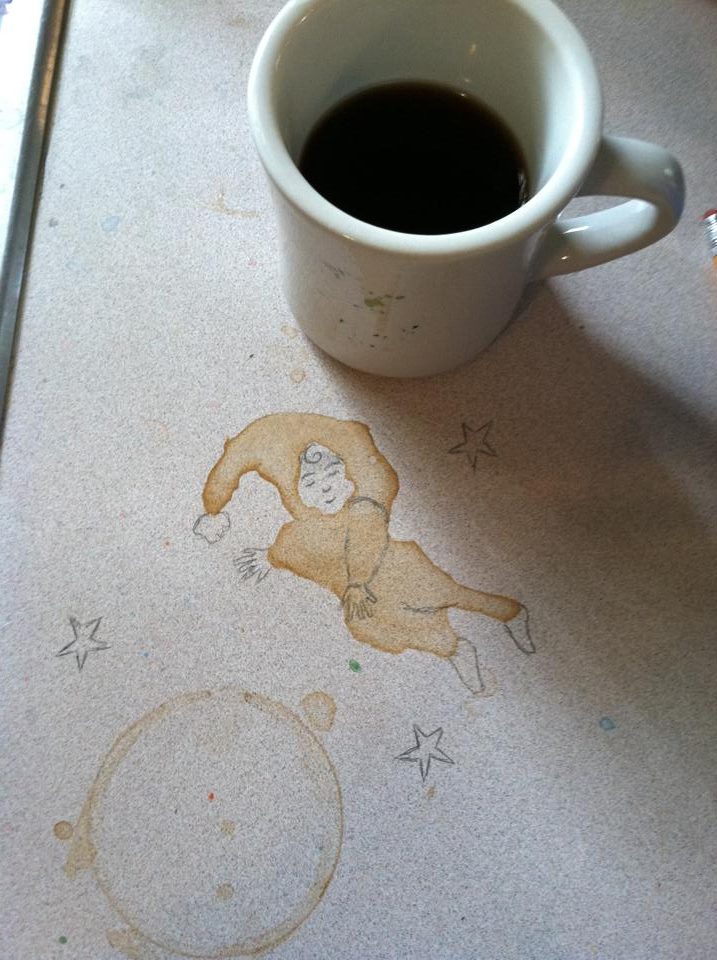
One morning, I was presented with a particularly impressive mess and I felt the familiar annoyance, but then I looked at the dark brown spill more carefully.  The shape resembled a figure.  I hurried into the office to get a drawing pencil.  All of sudden the careless mess left for me to clean up had become an inspiration.  With the addition of a few pencil lines, the spill had become a humble work of art.

 From then on, when my daughter left a spill, I turned it into art and posted it on FaceBook with a caption "Coffee Spills left by my Teenage Daughter Turned into Art".  I left the spills on the counter for the rest of the day to be appreciated by all.  Best of all, my day no longer started with an angry exchange between the two of us which negatively colored the rest of our day.  It makes me consider how other frustrating situations in life can be changed into something positive with a slight shift of perspective.  Next, I'm trying to figure out how to transform the clothing and wet towels my teenage son leaves in heaps on the floor into soft sculpture;) Stay tuned...


If you enjoyed this post, considering checking out my book, Approaching the Blank Canvas, Real Talk on Fear, Inspiration and Not Giving Up in Art and Life. It’s full of true tales and tips from my 20+ years of making art for a living. It’s available on Amazon Books and you can also find the link to it and my other books on my DesignsbyArianne website.   

Thursday, September 3, 2015

Appreciation of Color

"More varied than any landscape was the landscape in the sky, with islands of gold and silver, peninsulas of apricot and rose against a background of many shades of turquoise and azure."
Cecil Beaton

Last night I saw a black and white movie set in present day Paris. I realized that when you drain the color from the world, you see things in stark contrast. You are forced to focus more on the words and expressions of the characters, because you are not distracted by a kaleidoscope of color. Objects are reduced to their simplest form. I understand why a director or photographer might choose black and white, but to me the effect is cold in its simplicity and has a morose and lonely quality.

When I have a subject that I am interested in painting, sometimes I take a black an white photo. Doing this helps me to see the dark and light areas, the shadows and reflected light, as well as all those shades of gray. It becomes easier to put things in a scale from light to dark if you remove the distraction of color.  If you are new to painting, you might try this practice;  Take a photograph of a still life and, using your computer’s photo editing program, see what the image looks like with the highest contrast between black and white. Turn up the brightness. See what happens when all the shades of gray are gone. Then returning to the original photo, sketch the still life in pencil paying attention to the areas of light and dark.

Next, go back to your sketch and add colored pencil, and watch the image come to life. Sometimes removing color can reduce a subject or a problem to it’s simplest form, but you also remove the nuances of emotion and life that color invokes. Try this, stand at your font door and observe the view. For the next few days, look at the same view and notice the differences in the quality of colors at different times of day and in different weather. 

While observing things in black and white can be a useful tool in creating art, color is what gives life it’s flavor. If we see things only in the extremes of contrast, we miss out on all the wonderful, chaotic, messy color in between. 
-Arianne

Taking a Step Back

Taking a Step Back

One sees qualities at a distance and defects at close range.”
 
-Victor Hugo
 

At Sociable Art events, my guests sit and paint at tabletop easels leaving little distance between themselves and the canvas they are working on. In every class, I mention that artists need to step back from their paintings to see them clearly. My suggestion is always followed by laughs and someone joking that their painting would look better from halfway across the parking lot. Seriously though, being too up close and personal with your subject keeps you from seeing the painting as a whole.
 
I have attached an image of a close-up view of one of Monet’s paintings of water lilies. Not too impressive up close, is it? It is difficult to even tell what we are looking at. However, when you step back and view the whole painting from a distance, all becomes clear from your new vantage point. Monet was trying to capture his impression of the scene. Interestingly, he was suffering from cataracts when he painted most of the water lily paintings, and his eyesight was greatly diminished.
 
Try this; the next time you are painting, step back from your painting occasionally. When you view the painting from three or four feet away, you can suddenly see what was not apparent up close. Viewing your work, your eye should move easily around the painting. From a distance, you can see problem areas that are distractions and stop the flow of your vision.  It is evident where you need to add contrast between light and dark to form better definition between objects. The best thing is, almost always, your painting will look better to you from far away, even if that’s across the parking lot.
 
The same can be said of many situations in life. If you are faced with a problem at work, a difficult relationship, or any sort of dilemma, try taking a step back and create a degree of separation. When we are in the thick of things, right on top of the problem, we can’t see the forest for the trees Only from a slight distance, can we see all of the parts of a whole and gain an objective perspective to see what needs to be fixed and what is valuable and worth saving. I can’t tell you how many times at the conclusion of a Sociable Art event, a guest who has been sitting a foot away from their canvas all evening criticizing their own work stands up, steps back, and smiles with satisfaction when seeing their work from a distance.
 
Arianne
“Distance not only gives nostalgia, but perspective, and maybe objectivity.”
-Robert Morgan

 If you enjoyed this post, considering checking out my book, Approaching the Blank Canvas, Real Talk on Fear, Inspiration and Not Giving Up in Art and Life. It’s full of true tales and tips from my 20+ years of making art for a living. It’s available on Amazon Books and you can also find the link to it and my other books on my DesignsbyArianne website.   
 

Abstract Expression as Therapy

Abstract Expression as Therapy


The definition of abstract art: 
Art that does not attempt to represent external, recognizable reality but seeks to achieve its effect using shapes, forms, colors, and textures.
 
 “Energy and motion made visible – memories arrested in space” 
 

My mom was an artist.  When she was diagnosed with multiple sclerosis, her artistic style changed.  Not due to any physical limitations, her nerve damage was limited to the left side of her body, but more likely due to the mental challenge presented by dealing with an autoimmune disease.  When she was forced to accept that her body was attacking itself, I suppose she tried to find some control through artistic expression. After receiving her diagnosis, my mom could never see life in the same way, and so her art could never be the same.  Things she had taken for granted had become abstract.

She began to paint abstract paintings full of brightly hued patterns and shapes. They were neatly ordered puzzles of design and color.  She painted this style on any object that didn't move.  To the left is an image of a door she painted in her home.  

I have been told by others faced with chronic disease, that art is the one activity that allows them to forget their struggle for as long as they have brush in hand. 

A lot of people don’t understand art that doesn’t depict a recognizable object a subject matter, but art is not just about pretty pictures and skillful depictions of reality.     Sometimes the value of art is not just in the beautiful result but in the actual process of applying paint to white canvas; of the feeling you evoke with the motion of your brushstrokes and the drama of certain colors interacting with each other. If you think of art as an expression, sometimes abstract is the purest form..  You are trying to paint frustration, love, anger, music, the flow of the universe. 

Abstract art is our way of taking a complex, confusing, and demanding world and breaking it down into its essential elements: color form, movement, feeling. An artist may create an entire series of paintings designed to study the color pink – to explore how it interacts with other colors.

Abstract is an escape from rules, from conformity, from expectation. So the next time you look at a smear of gray paint on a field of yellow, try to see it without expectation and without preconceived notions of what art should be.  Appreciate the quality of the color, the motion of the brushstrokes, the simplicity  of form.  If you look very carefully, you may be able to see into the heart and soul of the artist.  The beauty of abstract is that it demands so little of us and gives to us whatever we are willing to take.

If you are in need of a little "art therapy", try this simple exercise:

1. Without over-thinking, quickly draw a loose pattern, shape, or scribble with a sharpie or paint pen on a blank white canvas.

2. Choose a palette of colors that are pleasing to you in your current state of mind.

3. Simply fill in each shape (with feeling!) using patterns, differing brushstrokes, alternating colors.

4. Voila! An abstract masterpiece!

The painting below was created by one of our teams at a Sociable Art Abstract Ensemble Team Building Event at Pinehurst Resorts and donated to The Carying Place.


If you enjoyed this post, considering checking out my book, Approaching the Blank Canvas, Real Talk on Fear, Inspiration and Not Giving Up in Art and Life. It’s full of true tales and tips from my 20+ years of making art for a living. It’s available on Amazon Books and you can also find the link to it and my other books on my DesignsbyArianne website.   


Finding Flow

Finding "Flow"


“…success, like happiness, cannot be pursued; it must ensue…as the unintended side-effect of one’s personal dedication to a course greater than oneself.” 
 -       Viktor Frankl   
 In the book, Flow, Mihaly Csikszentmihalyi describes a state of happiness and contentment called “flow” in which people are so involved in an activity that nothing else seems to matter and time loses meaning.  He goes on to say that this state is achieved by stretching the mind or body “to it’s limits in a voluntary effort to accomplish something difficult and worthwhile.”  Watch his TedTalk for more insights.

Sometimes we find our workdays so mentally tiring and stressful that we look for ways to “check out” in our free time, turning to passive forms of entertainment like television and the internet; however these only serve to keep us from truly experiencing real life and feel the great joy of challenging ourselves to grow and reach new heights.   

I am fortunate enough to be able to reach a state of flow when I am immersed in painting.  For others, flow may come from learning a new instrument, challenging the mind with puzzles, enjoying a competitive game of tennis, or from yoga and meditation. How do you achieve flow?    

 Think back to a time when you were involved in an activity and time seemed to race by.  Two hours passed and it felt like five minutes. Your mind was clear and uncluttered, free of racing thoughts and worries.  I have friends who achieve this state through knitting, programming, and cooking to name just a few pastimes.  The key is to try to challenge yourself to create something with a clear goal in mind.  After a night or weekend away from your 9-5 job, wouldn’t it be more satisfying to know you did not fritter away your free time watching reality television, but actually had something to show for your time, whether that be a hand knitted sweater, painting, chocolate cake, or new personal fitness record?   

 Recently I have had the pleasure of witnessing a friend take on a major challenge by confronting a major obstacle, her fear of swimming.  She has gone through her whole life avoiding water over her knees, because she never learned to swim.  Now, over the age of forty, she has gathered her courage and decided to “take a plunge”.  It is thrilling watching someone push their boundaries and often has the unexpected effect of influencing you to test your own limits as well.  I can only imagine the new sense of confidence my friend will have after facing her fear head-on, and I wonder what new opportunities and experiences will arise as a result. This is why it is important to surround yourself with people who are interested in growth; it rubs off!   

 Why not be the one to set the example?  Be the one among your group of friends, coworkers, or family who inspires through action.  Rather than coming to work in the morning with knowledge of which bachelor the current bachelorette chose, show up with plans to climb a mountain, photos of a garden you created in your backyard, or the peace of mind that comes from challenging yourself to improve and reach new heights.  I am training to complete the Pilot Mountain to Hanging Rock Ultra.   How do you plan to challenge yourself?

- Arianne


If you enjoyed this post, considering checking out my book, Approaching the Blank Canvas, Real Talk on Fear, Inspiration and Not Giving Up in Art and Life. It’s full of true tales and tips from my 20+ years of making art for a living. It’s available on Amazon Books and you can also find the link to it and my other books on my DesignsbyArianne website.  
 

Monday, March 25, 2013

Artist’s Block: Getting Out of a Creative Rut


Artist's Block, Getting out of a Creative Rut

“What is necessary to break the spell of inertia and frustration is this: Act as if it were impossible to fail.  That is the talisman, the formula, the command of right about face which turns us from failure to success.”
- Dorothea Brand

You are stuck.  When you pick up your paintbrush, pen or pencil, you feel paralyzed.  The work you do manage to create feels forced and uninspired.  You begin to avoid your studio, the blank canvas or sheet of paper.  You feel as if you are stuck in place, unable to move forward.  Your imagination has gone on vacation and neglected to leave a forwarding number.  When writers find themselves in a similar state of mind, it is called writer’s block.  You, my friend, have artist’s block. This too shall pass.

Creativity is an important part of everyone’s life whether you consider yourself an artist or not.  It is what adds the spice to life   We all go through periods of creative stagnation which can be caused by the monotony of routine, depression, stress, or unresolved conflict.  I have been a victim myself on occasion and have developed methods to lift myself out of a rut and back on track.  I refer to these steps as 1) step back, 2) move forward, 3) seek inspiration, 4) try something new,  and 5) turn off your brain.

1) Step back
Now that you have made the diagnosis, it helps to get a little distance from your daily routines, responsibilities and stresses, to gain perspective on your life and determine the source of your block.  I wrote an entire blog post on this subject. A trip to a Caribbean island would give you real measurable physical distance, but a plane ticket is not necessary to gain perspective.  Sometimes all it takes is a half hour of solitude on a park bench or a walk in the woods to get away.  So let’s say you discover that your ongoing feud with your neighbor who refuses to cut his grass is eating away at your peace of mind and causing your art to look like angry expressionism, now what?

2) Move Forward
It is not necessary to cure the cause of your frustration, because, let’s face it, sometimes you can’t.  You have to learn to maneuver around it and continue to move forward.  The definition of inertia is the resistance of any physical object to a change in its state of motion or rest, or the tendency of any object to resist any change in its motion.  The longer we stand still, the harder it is going to be to get up and move.  Water in a river continues to flow, even when there are rocks and logs in its path.  The stream simply flows around and over obstructions.  If you are momentarily stalled by a conflict or obstruction, just continue to move forward by taking a first step.  It doesn’t matter if you know the destination,  Just keep putting one foot in front of another.  I promise you’ll get somewhere even if your steps are clumsy or sloppy.  If you don’t move, you are guaranteed to stay stuck.  Keep putting pencil to paper, paintbrush to canvas, feet to the pavement.

3) Seek Inspiration
So now that your moving, it might help to gain a little direction.  Get guidance from people who are clearly inspired.  In other words, those that are not stuck.  Seek out those individual whose work you admire, whose positive attitude is inspiring, who seem to “have it going on”.   Visit art museums, browse through creative periodicals, search artist’s websites and blog posts, make new friends with new perspectives, and immerse yourself in nature.  Surround yourself with creativity and beauty.  Believe me, it will rub off.

4) Try Something New
You’re moving in some direction (though you are not sure where), and you’re feeling inspired.  Now it’s time to put your inspiration into action.  There is no better way to lift your wagon wheel out of a rut then to turn the wheel in a completely different direction.  Explore a new path. If you are a watercolor artist, try oils.  Try a new sport, pick up a new hobby, make a new friend.  Your creating new neural pathways in your brain. It’s a great way to wake your brain out of it’s slumber. 

5) Turn off Your Brain
Speaking of the brain, we all have heard of right brain/left brain, one side being responsible for creativity and one for logical, analytical thinking.  Well, let’s just give the logical “left brain” a little rest.  Try to stop over thinking.  Don’t worry about the outcome.  Let go of the internal critic.  Pick up your paintbrush or pencil and just enjoy the process.  Do it with feeling, not with thought.  I love this quote from The Little Prince: “It is only with the heart that one can see rightly.  What is essential is invisible to the eye.”

We all find ourselves in a rut from time to time.  The worst thing you can do is stay in it, rolling along a boring, lifeless path lost in the boredom of inertia.  Get some distance, gain inspiration, keep moving forward and turn off your left brain.  You can give the left side a nudge and wake it up when it’s time to negotiate a sales price for your newly created, incredibly inspired masterpiece.

Happy creating,
Arianne


If you enjoyed this post, considering checking out my book, Approaching the Blank Canvas, Real Talk on Fear, Inspiration and Not Giving Up in Art and Life. It’s full of true tales and tips from my 20+ years of making art for a living. It’s available on Amazon Books and you can also find the link to it and my other books on my DesignsbyArianne website.   

Seeing Like an Artist


Vision is the art of seeing what is invisible to others.
Jonathan Swift
One very important aspect of motivation is the willingness to stop and to look at things that no one else has bothered to look at. This simple process of focusing on things that are normally taken for granted is a powerful source of creativity.
Edward de Bono
I say repeatedly that everyone is an artist, some people just refuse to admit it to themselves.  If you won't entertain the idea, it will never happen.  Certainly, some people have been gifted with incredible skill, and you may never be able to create a masterpiece like The Mona Lisa.  You can, however create a beautiful and work of art. I think that what separates an artist from "the average person" is an ability to see fully and creatively.
An artist sees and appreciates all the little nuances of a scene  or an object and can express the way the sight makes them feel using a paintbrush. Say you are painting an apple, you need to really look at the apple and appreciate not only the shape of it, but the shape of the  negative space (the emptiness surrounding the apple) created around it, the variety of colors in the apple and the shadow it casts,  and the texture of the skin.
As an exercise, sit outside and take five minutes to observe your surroundings as an artist might.  I promise, you will see things with a completely new perspective.  The trees are not just green, but a myriad of shades and hues. Look at the graceful arch of the branches, how they overlap and disappear behind the leaves. Observe the texture of the ground beneath your feet.  Have you ever looked at a snail trail, how it positively sparkles and glistens in the sun?  Notice the shape of the clouds in the sky and also the shape of the blue sky between them. 
Then, the next time you are painting waves at a Sociable Art event, try to recall exactly what the waves looked like the last time you visited the beach.  Think of how they behaved as they washed ashore and broke at sea.  In approaching your art in this way, you will be adding emotion and authenticity to your work.  I am convinced that trying to see things more fully will not only make you a better artist, but it will also make you appreciate the world around you. 
Thanks for taking the time to read my thoughts.  Next time we'll talk about fear and how it cripples the creative process and limits your enjoyment of life.  Sounds a bit heavy, but I promise to keep it light;)
Arianne